
How to read a Japanese auction sheet
Every car sold at auction in Japan is inspected by a third party who has no stake in the sale, and their findings go on a single sheet. This is the order we read one in, and what we are looking for at each step. We translate the sheet in full for every car we bid on, but you should never have to take our word for what it says.
What you are looking at
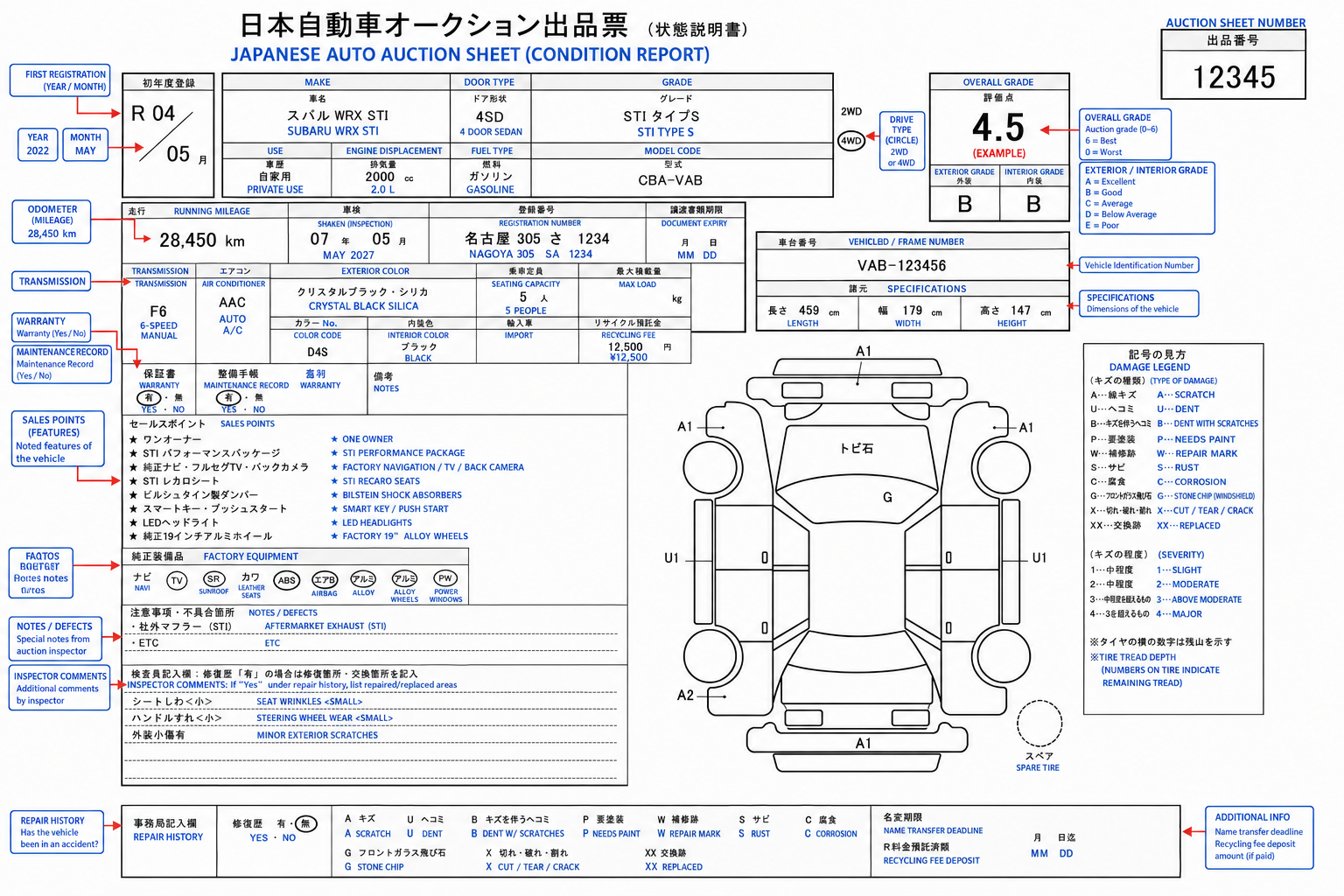
A sheet is dense by design — it has to fit a whole car onto one page. On a phone, tap it to open it full size and pinch to zoom; reading it shrunk to the width of a screen is not worth attempting.
Layouts differ between auction houses — USS, TAA, JU, HAA, Arai and Aucnet each set their sheets out slightly differently — but every one carries the same six things: identity, grade, mileage, a diagram of the car, repair history, and the inspector's notes.
Read it in this order
Working top to bottom stops you doing what almost everyone does: reading the grade, liking it, and never getting to the notes.
- 01
Confirm it is the car you think it is
Chassis number, model code and grade name, top-left. A GT-R is BNR32/33/34; a Skyline that is not a GT-R is ER34 or similar. The model code is the truth, the badge is not.
A model code that does not match the description you were sent is where most bad buys start.
- 02
Read the year properly
Japanese sheets often use era years. Heisei (H) 1 is 1989, so H10 is 1998. Reiwa (R) 1 is 2019, so R2 is 2020. Add 1988 to a Heisei year, or 2018 to a Reiwa year.
Year drives import eligibility. Get it wrong by one and a car that is legal to land becomes one that is not.
- 03
Take the overall grade
Large, top-right. It summarises exterior and mechanical condition on the scale below. Anything at 4 or above is a straightforwardly sound car.
R and RA are not low scores on the same scale — they mean structural repair, whatever the car looks like.
- 04
Take the interior grade
The letter next to it, A through D. Interiors are expensive to put right and impossible to photograph honestly, so this letter carries more weight than people give it.
- 05
Check the mileage — and whether it is believed
Distance is in kilometres, sometimes written in units of ten thousand. Look for a mark confirming the reading was verified against the service record.
Notes meaning replaced meter, unknown or tampered turn the mileage into a guess. Walk away or price it as unknown.
- 06
Read the car diagram
The outline of the car carries letters and numbers marking every fault the inspector found, in place. Cross-reference them with the code table below.
W, X and XX on a structural panel matter far more than A1 scratches all over the doors.
- 07
Look for repair history
A dedicated box states whether the car has accident repair history. Present, it outranks a good overall grade for resale.
Repaired well is still repaired. It follows the car forever and buyers will ask.
- 08
Read the inspector's notes
Handwritten, usually at the foot, always in Japanese. This is the most valuable part of the sheet and the part auction listings leave out: oil leaks, noises, warning lights, smoking on cold start, non-standard parts.
A grade 4 with a note about engine noise is a worse car than a grade 3.5 with clean notes. We translate these in full before bidding.
- 09
Check equipment and modifications
Shorthand marks the factory options — power steering, power windows, sunroof, alloys, leather, navigation, air conditioning. Aftermarket parts are usually called out separately.
Modifications can affect compliance on arrival. Original parts included is worth real money.
- 10
Check the roadworthiness expiry
Shaken is Japan's inspection certificate and its remaining term is on the sheet. It has no legal meaning once the car is exported.
Irrelevant to you as an importer, but a long remaining term often signals a car that has been kept up.
The overall grade
The number in the corner. It covers the outside of the car and its mechanical condition together.
- SNewEffectively unregistered. Delivery mileage only. Rare at auction and priced accordingly.
- 6As newAlmost no wear, very low mileage. Treated as new by most buyers.
- 5ExcellentLow mileage, no meaningful cosmetic faults. The best you will realistically find on a car of any age.
- 4.5Very goodLight wear consistent with careful use. Small scratches at most. The sweet spot for a well-kept enthusiast car.
- 4GoodHonest, tidy, used. Visible minor marks and normal wear. Most of what gets imported sits here.
- 3.5AverageNoticeable cosmetic wear — scratches, dents, kerbed wheels, tired interior. Fine if the price reflects it and the notes are clean.
- 3Below averageSignificant wear or damage. Usually needs paint or panel work. Read the inspector's notes twice.
- 2PoorHeavy damage, heavy modification, or very high mileage. Bought as a project or for parts.
- 1Modified or damagedExtensively modified, or flood, fire or mechanical damage. Grade 1 is a warning, not a score.
- R · RARepair historyThe structure has been repaired after an accident. RA is the lighter of the two. The car may look perfect — the grade is about what happened, not how it looks now.
- ***Not gradedThe inspector could not or would not grade it. Treat as unknown, never as neutral.
The exterior and interior grades
Two boxes on the sheet, one for the outside and one for the cabin, both on the same A to E scale.
- AExcellentClean throughout. No burns, tears or notable staining.
- BGoodLight wear in the usual places — driver's bolster, pedals, steering wheel rim.
- CAverageObvious wear for the age. Marks, tired trim, a worn driver's seat. Normal, not alarming.
- DBelow averageStains, cigarette burns or torn upholstery. Fixable, rarely cheaply.
- EPoorDamaged or heavily soiled. Assume a full retrim.
What the letters on the car mean
The outline of the car is marked wherever the inspector found something. So A1 on a door is a slight scratch; U3 on a wing is a dent worth arguing about.
- 1Slight
- 2Moderate
- 3Above moderate
- 4Major
- A
Scratch
線キズ — the most common mark of all
- U
Dent
ヘコミ — pushed in without breaking paint
- B
Dent with scratches
キズを伴うヘコミ — both at once
- P
Needs paint
要塗装 — the panel wants respraying
- W
Repair mark
補修跡 — bodywork has been done here before
- S
Rust
サビ — check where; sills and arches matter most
- C
Corrosion
腐食 — further along than S
- G
Stone chip
飛び石 — usually the windscreen
- X
Cut, tear or crack
切れ・裂け・割れ — common on bumpers
- XX
Replaced
交換済 — the panel is already a new one
We do this for every car we bid on
Before we place a bid on your behalf you get the sheet, a full translation including the handwritten notes, and an inspector who has stood next to the car. If any of the above appears, we tell you and we move on to the next one.
Grading is broadly consistent across the major Japanese auction houses but is not standardised between them, and no house publishes a binding definition. Treat this as how the scales are commonly read, not as a guarantee of how any individual sheet was written.